
Syracuse Traffic Court Records
Traffic court records in Syracuse are managed through the Syracuse City Court and the Syracuse City Traffic Violations Bureau. The city sits in Onondaga County and falls under the Fifth Judicial District. If you get a traffic ticket in Syracuse, you will deal with the city court at 511 South State Street. This page covers how to find your case, pay a fine, and understand how the local court system works for drivers in the Syracuse area.
Syracuse Traffic Court Quick Facts
Syracuse City Traffic Court Records Violations Bureau
The Syracuse City Traffic Violations Bureau handles moving traffic violations issued within the city limits. It is located at 511 South State Street, Syracuse, NY 13202. The phone number is (315) 473-2838. This is the office you contact if you have questions about a traffic ticket, need to check on a court date, or want to find out the status of a case. The bureau works under the Syracuse City Court, which has jurisdiction over traffic infractions, misdemeanors, and other local violations.
Syracuse is one of the cities in New York that participates in the DMV parking scofflaw program. If you have unpaid parking tickets, the DMV can block your vehicle registration until you clear the balance. The city court also handles moving violations like speeding, running a red light, and failure to yield.
The NYS DMV Parking Scofflaw Jurisdictions page lists Syracuse as a participating city with contact details for the Traffic Violations Bureau.
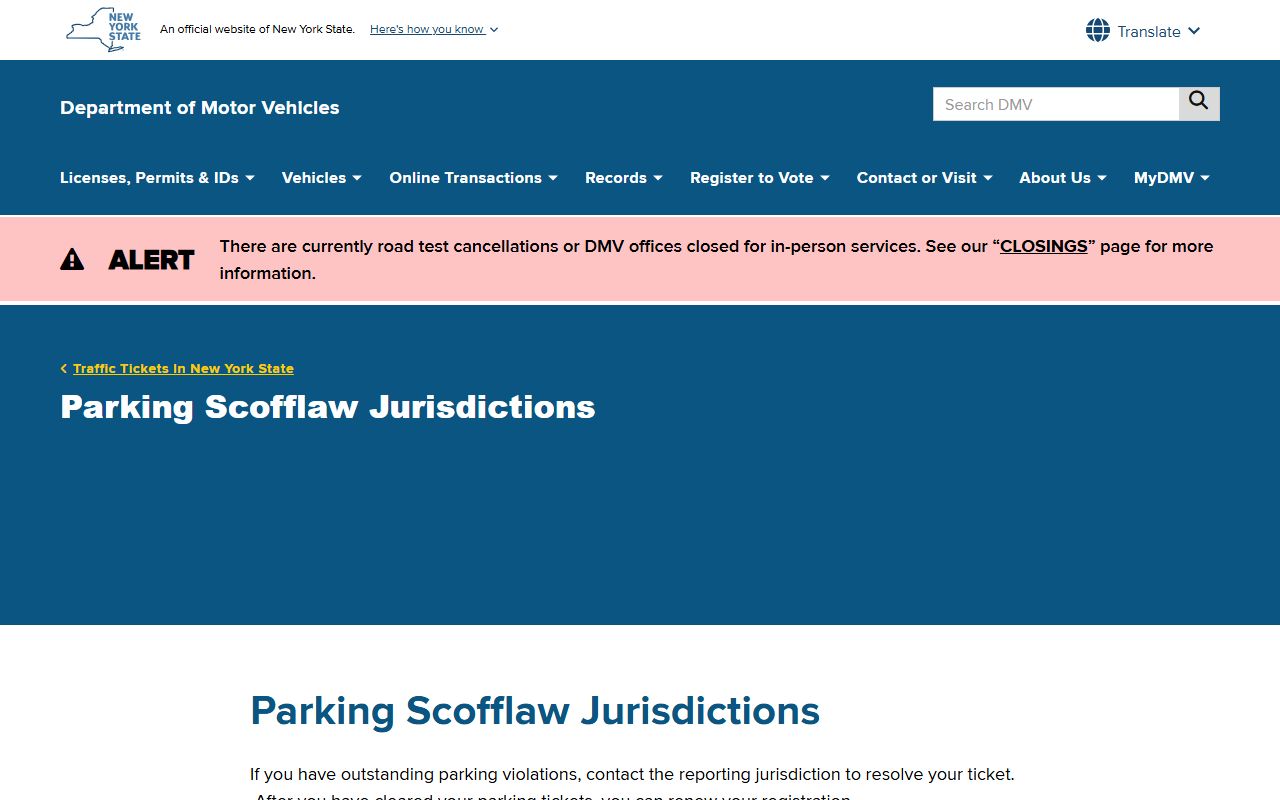
The listing confirms the bureau address and phone number for drivers who need to resolve outstanding tickets in Syracuse.
How to Handle a Traffic Court Records Ticket
When you get a traffic ticket in Syracuse, the ticket itself tells you what to do next. You usually have 15 days to respond. You can plead guilty and pay the fine, or you can plead not guilty and request a hearing. The plea options are listed right on the back of the ticket.
To plead guilty by mail, check the guilty box, sign the ticket, and send it to the court with your payment. Money orders and certified checks are the safest way to pay by mail. To plead not guilty, check that box and mail the ticket back. The court will then schedule a hearing date and send you a notice.
If you miss the deadline, the court can find you guilty by default. That means you lose the right to fight the ticket. The court will set a fine, and the DMV will add points to your record. Failing to pay can lead to license suspension. So even if you plan to contest the charge, make sure you respond on time.
At a hearing, the police officer who wrote the ticket presents evidence first. You can cross-examine the officer, call your own witnesses, and show your own evidence. A judge decides the case. Unlike TVB hearings in New York City, local courts in Syracuse sometimes allow plea bargaining. That means you may be able to negotiate a reduced charge with the prosecutor before trial. This is one reason many drivers hire a traffic lawyer for their case.
Syracuse Traffic Court Records
Syracuse City Court accepts several forms of payment for traffic fines. You can pay in person at the court clerk's office during business hours. Accepted methods include cash, money orders, and certified checks. Personal checks may not be accepted -- call the court first to confirm.
Online and phone payment options may also be available. Many New York courts use third-party services like PayCourtOnline.com for credit card payments. A convenience fee applies when you pay by card. Check with the court at (315) 473-2838 to see what payment methods are currently available for your case.
If you cannot pay the full amount right away, ask the court about a payment plan. Judges in local courts can sometimes set up installment agreements. You will need to appear in person to make that request.
Points and License Impact
New York tracks points on your driving record. Each traffic conviction adds a set number of points. Speeding 1 to 10 mph over the limit is 3 points. Running a red light is also 3 points. Higher-speed violations carry more points -- going 31 to 40 mph over the limit adds 8 points. If you hit 11 points in 18 months, the DMV suspends your license.
Three speeding or misdemeanor convictions in 18 months can also trigger a suspension, even if you have not reached 11 points. The NYS Driver Point System explains how points stack up and what each violation costs.
You can take a DMV-approved defensive driving course to reduce up to 4 points on your record. The course also qualifies you for a 10% discount on your auto insurance for three years. It does not remove the conviction from your record, but it does lower your point total for suspension purposes.
Searching Court Records
To look up a traffic court record in Syracuse, start with the court clerk's office. Call (315) 473-2838 and provide your name, date of birth, or ticket number. The clerk can tell you the status of your case, your next court date, and any fines owed.
For driving record abstracts, the NYS DMV Records portal lets you request a copy of your driving history. This shows all convictions, points, and suspensions tied to your license. You can order it online through the MyDMV portal for a fee. Employers and insurance companies also request these records when reviewing your driving history.
The NYS Courts records page has general information on how to get court records across the state. Some records are available online, while others need an in-person or mail request.
Onondaga County Court
Syracuse sits inside Onondaga County. The county court at the Onondaga County Courthouse handles felony trials and hears appeals from local courts, including Syracuse City Court. If you want to appeal a traffic conviction from Syracuse, the county court is where that process starts.
Other towns in Onondaga County have their own justice courts. If you got a ticket in a town outside Syracuse -- like Clay, Cicero, or DeWitt -- your case goes to that town's court, not Syracuse City Court. Always check the court name on your ticket to make sure you go to the right place.
Nearby Cities
These are some nearby qualifying cities in central and western New York. Each has its own court system and procedures for traffic cases.